




| TAMI Show | Village Of The Giants | Mondo Bizarro | Cutters Way aka Cutter And Bone |

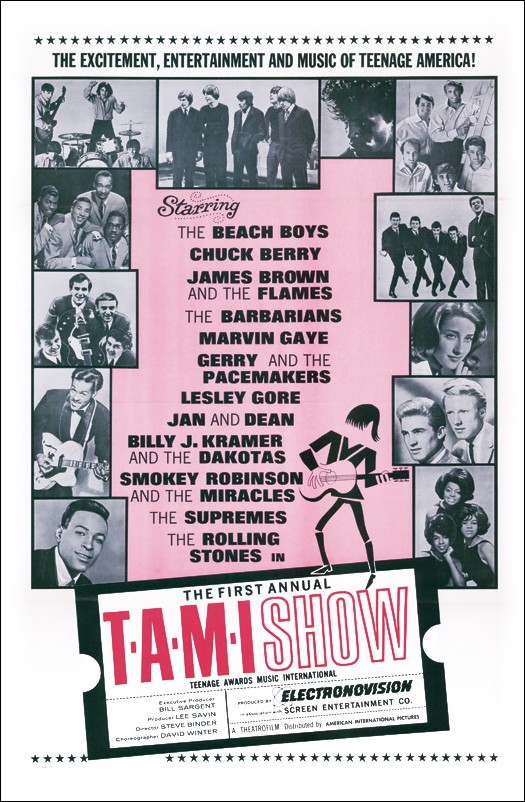
I've been called to task, rightly, over not noting the T.A.M.I. Show DVD on Shout! release.
You all know off it and maybe think you've got it, seen it and don't need a 'new' copy. Well you're wrong. It's the best $10s / £10 you can spend.
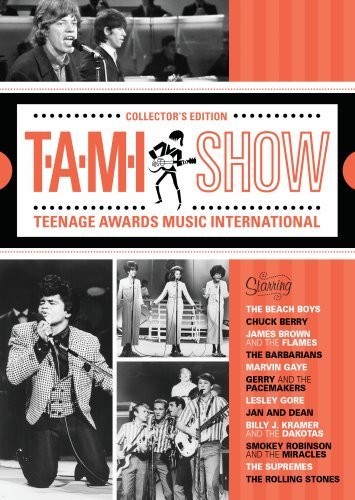
Buy Your Copy
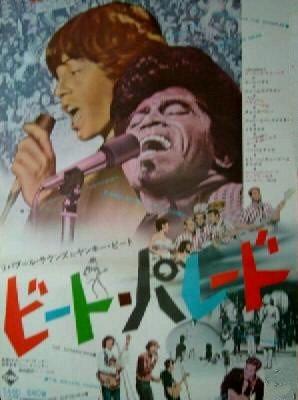
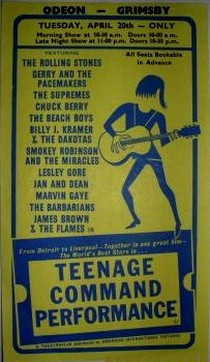
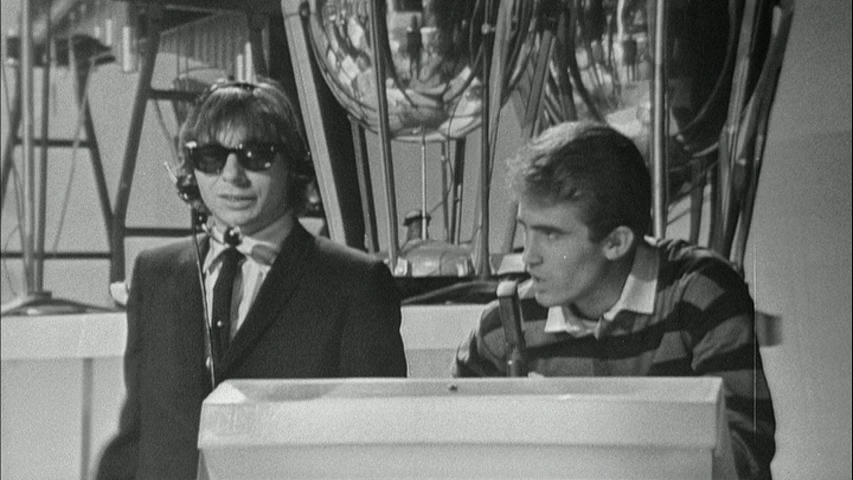
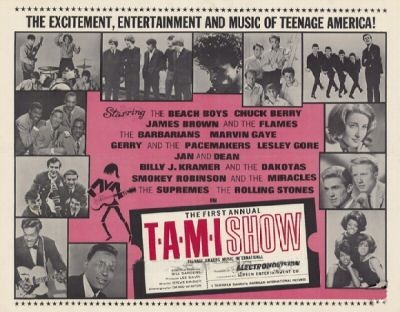
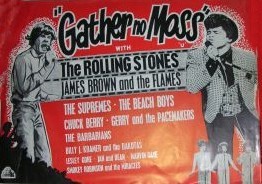
Were you one of those really cool cats who caught the show live at the Santa Monica Civic Auditorium? No? Possibly you were thrilled by the film's premier in "Electronovision" or caught the movie on its national release pre-matinee in Boston, MA? Still not, where do you come from overseas? Surely then you caught the film in Toyko, Japan or rushed out after eating your kippers one freezing night in April to the Odeon picture palace in Grimsby? Shame, like me you were too young or missed 'em all. Never mind at least now, thanks to those wonderful people at SHOUT! you can pretend your 15 years old again. Turn the lights down, volume up, sneak a fag, grab a coke and shake your head (even your hair if you're lucky) to what is still the grooviest music on the plant. And all of it bearing the credit that graces sooo many of the best 7" & 12" slabs of plastic: "ARRANGED AND CONDUCTED Jack Nitzsche".
Cooled off a bit now, although I'm still trying to banish the vision of the bikini clad gyrations of the top heavy go-go dancer, (apparently, if I've understood Steve Binder's commentary correctly, this is Joy Ciro later to be Mrs. Bobby Hatfield) had a good wash-down and it's time for a serious critique.
The show, or at least parts of it has been available in varying quality from poor to fair but to see and hear all of it in this clean & clear DVD is a revelation. Black and white artists performing together may have been one of the talking points of the movie then but what is so refreshing now is the mixing of the different musical styles pop, soul, garage, surf, girl-group, British Invasion etc.
Compulsory now for DVD releases to come with a host of 'extras', most of 'em a waste of space. There is no un-released footage to use from The T.A.M.I. Show but the DVD producers have added some very worthwhile bonuses; a colour booklet with the history of the T.A.M.I. Show by music historian Don Waller, the original trailer, 4 radio adverts and a cool chance to pick and choose your favourite songs. The highlight for me however is film director Steve Binder (and Don Waller)'s commentary on the recording. Steve is knowledgeable, informative and entertaining, the details he remembers and the warmth and obvious respect he feels towards the artists is infectious.
The earliest interview I know, so far, with Jack Nitzsche was by David Griffiths in the UK for British pop magazine Record Mirror dated October 3, 1964 and the reason for this interview? The T.A.M.I. Show. Jack is credited in the movie as "Arranger and Conductor" (he also played electric piano in the band), important enough but his input is even more than that. Steve Binder, the director credits Jack Nitzsche as first approaching Bill Sargent with the idea of filming a rock n roll concert and suggested a lot of the artists to appear in the film. Talking to David Griffiths Jack sounds very excited about the movie and interestingly includes The Four Seasons amongst the artists appearing. (In the DVD booklet Don Waller mentions that "reportedly, The Four Seasons were approached but wanted too much money ($45,000)". The reason for Nitzsche's UK visit was to talk over the arrangements he was writing with Gerry and the Pacemakers and Billy J. Kramer and the Dakotas, he already knew The Rolling Stones by now. And a task that proved beyond him, finding a female version of The Rolling Stones to appear in the movie!
As well as being responsible for putting together many of the best & now legendary West Coast studio musicians for the backing band and it must be assumed his long time collaborators The Blossoms on B-vox Jack also had recording engineer Dave Hassinger hired as 'Audio Consultant'. Other friends and music colleagues Nitzsche involved in the T.A.M.I. Show were Jackie DeShannon & Rod McKuen. Steve Binder recalls the pair huddled in Electronovision offices at 9130 Sunset Boulevard, later the home of Phil Spector's Philles Records, prepping the songs into melodies to fit the time frame the various artists had.
A Show of 'Stars' on stage but behind the floodlights I hope I've made the case that Jack Nitzsche's input in creating this audio and visual spectacular deserves to rank alongside other backroom stars such as Steve Binder's direction and Bill Sargent's vision.
(June 2011)
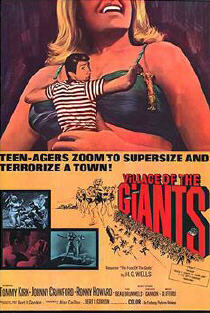
The plot is daft, the sets are flimsy and the acting is wooden but, as Mike implies, it's great fun after a six-pack or two! And certain scenes, when the music is pounding, really do deserve to be seen and heard stone cold sober.
If you want to know a bit more before parting with your cash, a colourful review can be found at Brian's Drive In Theater.
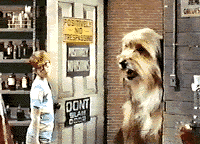
Now out on DVD in both the US and UK, "Village Of The Giants" was Jack Nitzsche's only 60s' film soundtrack. It was in the theaters in 1965, five years before his next work, "Performance".
This film was the brainchild of Bert I. Gordon who was producer, director, scriptwriter and special effects maven; a feat he previously achieved with the sword and sorcery film, "The Magic Sword", in 1962. Sorcery is at play in "Village Of The Giants" too, as a character named Genius played by Ron Howard invents a substance that makes living things grow to huge sizes. By both design and accident, the potion is first applied to a cat, a dog, two ducks and a spider. Genius hangs with some good guys, who include Tommy Kirk and Johnny Crawford and who want to use the formula to benefit mankind. These plans are thwarted when a group of bad teens (led by Beau Bridges) come to town and use Genius' invention on themselves with the result that they take over the town. Fortunately Genius invents a reversing agent that gets applied to the bad guys who then return to normal size and are run out of town.
Jack Nitzsche's music hits you straight away as the big sounding theme is played over the opening titles. The theme was released on 45 a year earlier as "The Last Race" and it is much heavier than his "Lonely Surfer" hit from 1963. The theme gets put to great use when the bad teens turn into giants and celebrate by dancing go-go style but at a pace that's right in sync with Jack's booming theme.
As with any self-respecting 60s' teen film, there's a curious mix of music acts involved. The Beau Brummels keep things right up to date with Beatle-style haircuts that let us know it's 1965. They perform "Woman" and "When It Comes To Your Love", both from group leader, Ron Elliott. (These songs are now on the Sundazed reissue CD, "Beau Brummels - Vol 2"). Toni "Mickey" Basil appears as a go-go dancer during their set and the giant ducks can also be seen bopping along. One of the ducks is rotisseried the next day at a cook out at which Freddy Cannon is a guest. Although he charted in the US in 1965, Freddy looks and performs just as he did five years earlier. His song, "Little Bitty Corrine" was written by him and Frank Slay and appeared on 45 as the b-side of "She's Something Else". Mike Clifford's chart run was over by a couple of years by the time he appeared in "Village Of the Giants" but he turns in a nice performance with the Jack Nitzsche-Russ Titleman ballad, "Maryann", which was not released.
"Village Of The Giants" has a hot cast: Tommy Kirk, Ron Howard, Toni Basil, Beau Bridges and Johnny Crawford (who doesn't sing) keep the plot moving along. Howard, Basil and Bridges all went on to have very successful careers. Tommy Kirk made at least six "Beach Party" knock-offs starting with "Pajama Party" in '64 and running through "It's A Bikini World" in '67. Needless to say, he fits right in here.
But this is really Jack Nitzsche's film as his soundtrack adds drama when there is really not much given up by the cast. It is best summed up by a line from Marshall Crenshaw's book, "Hollywood Rock": "Jack Nitzsche's theme song thunders throughout the proceedings, typifying what is - beyond any doubt - the most dramatic soundtrack I've encountered in a rock 'n' roll film".
Mike Edwards
(November 2003)
You've read the article and feel cheated there isn't actually a film review? Check these sites:
Grindhouse Cinema Database
Mania: Beyond Entertainment
DVD Drive In review
Samples of the music
Surf Finger
(Vocal by Claude Emmand).mp3
We're Gonna Save The World.mp3
We're Gonna Save The World(2).mp3
Jiggling Jugs.mp3
(The opening scene set in a ladies lingerie shop filmed behind a two-way mirror in the changing room. The music reflecting the ladies charms and ethnic origins. Classy)
If you can help with Nitzsche's involvement (or not) in the music, have more information to share or have any other comments please send an email.
Thanks to Elliot James, Marty Cooper, Denny Bruce & Mark Linnet.
Mike Edwards (and I) thought "Village Of The Giants" was Jack Nitzsche's only 60s film soundtrack but we were wrong.
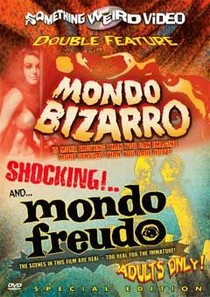
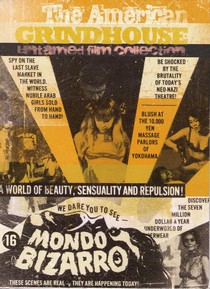
Forty-one years before Quentin Tarantino's present day exploitation movie "Death Proof" roared on the screen to Jack Nitzsche's pounding opening number "The Last Race"*1 his equally dramatic "Surf Finger" was used as the main theme for the 'cult-classic' "Mondo Bizarro". The inclusion of this and other works by Mr. Nitzsche in the movie is even more 'Bizarro' than what is seen in the film.
Elliot James wrote to Jack Nitzsche's site with this enquiry:
"There is a 1966 film called Mondo Bizarro with music by someone called Lawrence Von Lattman which I believe is a pen name.
The recurring music theme sounds very much like The Last Surfer. It has the same kind of "war cry" lick that is used in Surfer and has the same incredible wall of sound arrangement. The theme begins almost immediately in this trailer.
Movie Web, Mondo Bizarro trailer
I'm convinced this is Nitzsche. It's been hopeless trying to find the track anywhere but this movie. It's a tremendous piece of music, oddly neglected."
Soon as I heard it I knew it was by Mr. Nitzsche but it took a little while to realise which track.
"Surf Finger", up there with the best of his Reprise instrumental recordings, first came to my eager ears from a CD-r that the tunes co-composer Marty Cooper sent. Later released on Ace Records "The Jack Nitzsche Story Vol. 2" the known history of the recording can be found on a ROTW Review of David Rose's recording of the track, released as "The BlowUp" on the liner notes to the Ace CD and Marty Cooper's Produced By... The big question is how the hell did it turn-up, in 1966, on a ropey little film like "Mondo Bizarro"?!?
I started making enquires and naturally the first person I contacted was Marty Cooper:
"Here is what I remember.
Jack, for some reason, decided to make some kind of arrangement for his copyrights with a guy named Aaron Schroeder.
I have no idea if Jack ever knew about Bizarro but I am pretty sure that someone got the recordings from Schroeder and then just used them for free with the phony credit.
I don't know if anything can be done at this stage other than mentioning the illegal lift in your pages.
I still believe that "Surf Finger", "Puerto Vallarta", "Old Town" and "The Lonely Surfer" would make great movie themes.
So it goes.
Onward
MC
Marty is quite right, David Rose's recording of "The Blowup" was published by Marty's Little Darlin and Aaron Schroeder's January Music Corp. Combine this with Billboard's note in the August 28th 1965 issue that "Composer - arranger Jack Nitzsche was being groomed for film-TV chores by his new manager Helen Noga*2. Nitzsche has already met with Screen Gems officials to discuss film work." Quite obviously Jack would have been circulating tapes of his recordings designed to demonstrate his composing and producing skills and I assume this is how the producers of the film got to hear the tracks.
I say tracks because "Surf Finger" is joined in the soundtrack by other known Nitzsche recordings, a snippet from the 'walking' intro to "Senorita From Detroit" (again co-written by Marty Cooper) among them. Many of the instrumental cuts have the 'Nitzsche sound' but even the ones without an obvious Nitzsche musical reference could very easily be his. There are also a couple of vocal tracks.
Two demo versions are heard of Randy Newman's unreleased "We're Gonna Save The World". One a full length version with piano and Randy on vocals the other an unidentified lone male vocal on just the one verse. Despite Jack only receiving a couple of label credits on Randy Newman's own records "Gone Dead Train" & "Let's Burn Down The Cornfield" his and Randy's work together goes way back. Very easy for me to believe Jack was behind the studio board when these were recorded. The other vocal cut is very 'garagy' (reviewed by Mania as "a bitchin' rock tune ") that sounds like it could be (but apparently isn't) an outtake from the 1965 session that Jack produced for The Regents. Shame, could it be The Gas Co.? Of course it could be neither but if you needed music for a film, on the cheap and had a tape chock full of music you didn't recognise and were going to use leaglly or otherwise why look for other recordings? If you share my feelings that much/most of the soundtrack is by Jack Nitzsche it seems unlikely, as has been suggested that the music came courtesy of a record industry library but direct from a sample tape showcasing Mr. Nitzsche's many talents.
Jack was a fan of the fist 'Mondo' film "Mondo Cane", Denny Bruce tells me that Jack once dragged him into a flea pit cinema that was showing a re-run of the movie and of course he released his own version of "The Theme From Mondo Cane (More)" on his "The Lonely Surfer" album. Even so I can't believe Jack, Helen Noga or Aaron Schroeder were complicit in this music's release. So not only do I accuse the people behind the movie of being liars, I don't think the Nassau, Yokohama, Hamburg or Lebanon scenes were really shot abroad but thieves as well! (Although I do give 'em praise for their musical taste!)
(May 2011)
*1 Jack Nitzsche later re-recorded "The Last Race" for use as the main movie theme for "Village Of The Giants".
*2 Name ring a bell? Should do, among her résumé, she had 'discovered' Johnny Mathis and managed his career until 1964, refusing to let him be a victim of the Las Vegas' color bar and financed the early Crystal's records for Phil Spector's Philles label.
Thanks Michael for writing the review for the site.
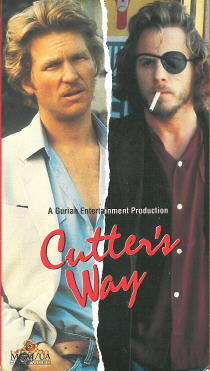
To help you make up your mind another review of the film can be found at Pop Matters Film review site.
Eric Harry played the glass instruments on the score and I'm delighted that he's written a piece on working with Nitzsche for The Jack I Knew page.
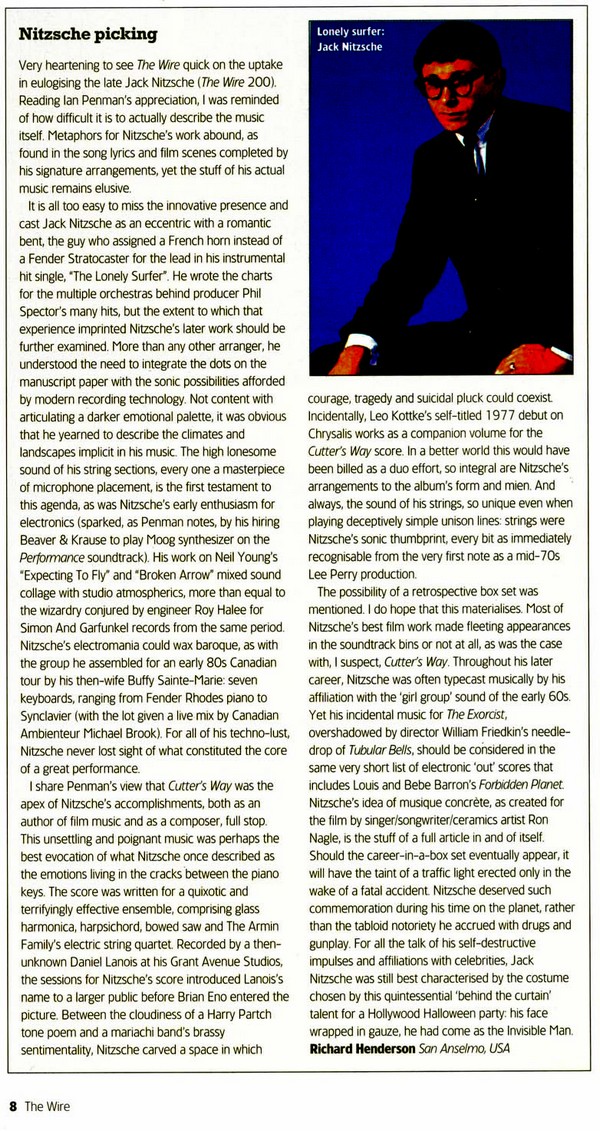
Click for full sized scan
Amongst the many eulogies to Mr Nitzsche appearing in the UK press towards the end of August 2000, I found myself drawn in particular to a small number of them: Andrew Loog Oldham's of course, Philip Brophy in "Senses of Cinema" relating Jack's trip to the Melbourne Cinesonic; and Ian Penman's heartfelt piece in "The Wire".
In most of the other obituaries (ignoring those that focused on his brushes with the law etc) the scales were stacked in favour of the admitedly priceless productions he'd constructed during his time in the music industry, the bejewelled flourishes on the vintage Neil Young and Rolling Stones recordings for example. But after considering the "Performance" soundtrack, separated from that film's alternately vicious and hallucinogenic imagery, I was intrigued to hear more of Nitzsche's soundtrack work.
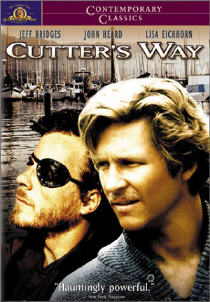
Ian Penman had mentioned that the soundtrack to "Cutter's Way" (dir: Ivan Passer, 1981) was one of his own personal favourites, so I decided to track it down.
Needless to say the movie wasn't available in the UK, but through the diligent resources of a good friend in Toronto (who shall remain nameless for contractual reasons) I duly ended up with a VHS tape of the film.
Jack Nitzsche's music is used here very sparingly, but to telling effect, in this dark tale of corporate greed, embittered Vietnam veterans and reticent drifters.
The movie opens with a snatch of mariachi music, followed by the eerie glass harmonica (played by Eric Harry), reminiscent of the ringing wineglasses in Neil Young's barn at the end of "On The Moodus Run"; then a poignant theme played over the opening credits on zither (by Walter Repple), this unlikely combination of glass harp, zither & electric strings recurring like a motif at key moments throughout the duration of the film.
More mariachi music introduces itinerant gigolo Richard Bone (a young Jeff Bridges) leaving an unnamed married woman's bedroom, accepting money and skulking into the light of day.
Strange white horses stray across the screen, as if in a waking dream, as he waits at traffic lights during a rainy drive across town and then on to the deserted alley where, unknown to him, a gruesome cargo is being deposited.
Eight minutes into the movie and we meet the initially reprehensible Alex Cutter, friend of Bone, getting tanked up and holding court in some sleazy barroom on the wrong side of town; and - there it is - the unmistakeable repeating blues figure of "Little Al" (from Nitzsche's unreleased 1974 solo album) rumbling in the background as Cutter (played to great effect by John Heard: pitched somewhere between latter-period Dennis Wilson and Long John Silver) talks himself into ever deeper waters, and almost into a sound thrashing by the local clientelle.
Five minutes later and we've made the aquaintance of Mo (Lisa Eichhorn), Cutter's alcoholic but beautiful wife, and a welcome reprise of the poignant main theme.
(Why the hell isn't this soundtrack available on CD? - are you listening Rhino Handmade? And let's have a Region 2 DVD of the movie while we're about it!).
Nitzsche's immaculate score perfectly echoes the visuals of "Cutter's Way" throughout, the various interiors, mainly shot in muted tones; the music deftly matching the damaged, dishevelled lives of the three main protagonists: Cutter, Bone and Mo.
More mariachi music while they sit watching the parade pass at the afternoon fiesta with a tequila-soaked Cutter on the loose. Marching bands, fat men on horses; Mo biting her lip at Alex's indelicate & abusive rages.
The reappearance of the glass harmonica, a haunting sound, as Richard Bone's hired boat drifts calmly out across the waters of the marina where he works, a brief respite from the travelling life.
And then, we have what I take to be a rare previously-unheard Jack Nitzsche song, just over halfway through the film, during a sombre and touching, if knowingly illicit, love scene between Bone and Cutter's wife, played out against "We're Old Enough To Know" (music by Nitzsche, lyrics penned by John Byrum) and the unmistakeable (if you've been listening to the 1974 solo album) cracked timbre of Jack himself singing - yet another good reason for an official soundtrack CD!
Trademark high-register strings accompany the bereaved Alex in the next scene after a fatal fire has broken out at the homestead while he was away in LA: when asked if he needs a drink he declines, barking: "It's the daily grind that drives me to drink; tragedy I take straight..."
There is a rousing and vengeful climax to "Cutter's Way", set in the bright privileged sunshine of JJ Cord's garden party: the mariachi band returns, flamenco guitars and resounding trumpets; overlaid with the main theme breaking into a galloping pace and reaching its inexorable conclusion.
A fine, well-observed film, too muted and sombre for many tastes I would imagine; but the characterization is more than credible; and Jack Nitzsche's haunting and insinuating score makes it one of those movies that remain in your consciousness long after the lights have gone up.
Michael Kemp
(February 2003)